 EN
EN

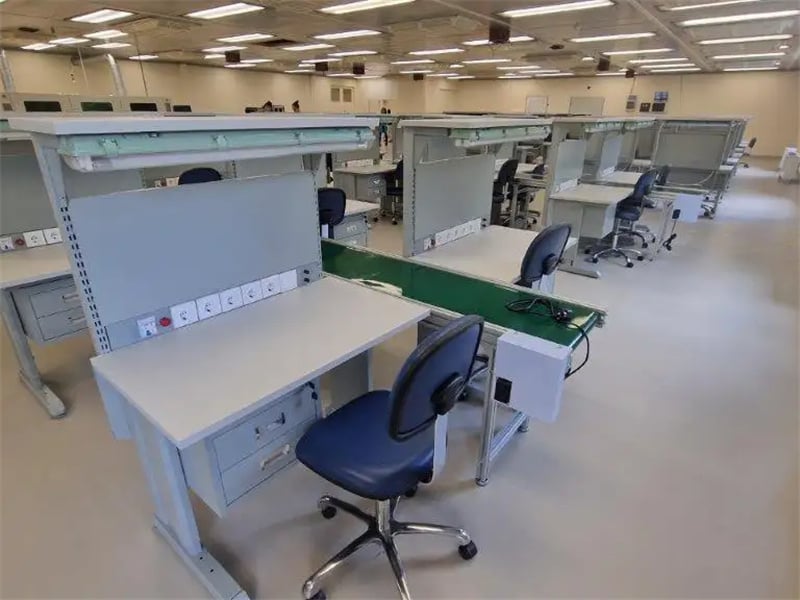
Failure rates are a story in electronics manufacture. Every failure of a component is more than just lost material, it's lost labor, shipments being delayed, and customer dissatisfaction. The majority of these failures are a result of one root cause, which is usually hard to detect: electrostatic discharge. The foundation for consistent quality control, and measurable reduction in rejection rates, is a properly designed ESD work table with static dissipative properties.
The Link Between ESD and Product Failures
Damage to a sensitive electronic component may not be apparent, when the static charge is released into the component. In other cases the failure is more catastrophic, and the component just fails to function. The damage is usually latent, however. The component meets the initial test, but fails in the field, resulting in expensive returns and warranty claims.
An industry analysis indicates that the use of ESD-proof workstations can minimize failures resulting from ESD up to 60%. This cost savings is significant for a mid-size electronics manufacturer, with the potential to save hundreds of thousands of dollars annually. The answer is simple: a static-dissipative ESD work table gives static charges somewhere to go that will not expose sensitive components to static charges.
How Static-Dissipative Surfaces Protect Components
The surface resistance of a properly specified ESD work table is 10⁶ to 10⁹ ohms, within the range specified in standards ANSI/ESD S20.20 and IEC 61340-5-1. This 'static-dissipative' range is important because it enables the static charge to dissipate gradually and safely, instead of being discharged into a component unexpectedly.
The design of a two-layer ESD mat is particularly effective. The upper layer is dissipative to set the discharge rate, and the lower layer is conductive to provide a good path to ground. This surface is connected via a wrist strap to the same grounding point as the operator; therefore, the entire work station is at the same electrical potential. This eliminates the voltage differences which lead to damaging discharges.
Consistency That Supports Quality Control
When ESD protection is inconsistent, rejection rates can often be high. Table that is good in one humidity can be poor in another. Over time, surfaces can deteriorate and cause unpredictable results. A good ESD work table is designed to deliver reliable performance.
Quality ESD work tables have a consistent resistance over a broad range of humidity 10% to 60% or greater. The 25mm thick HPL laminate work surface is engineered for long lasting static dissipative properties while also being used in daily industrial applications. This uniformity enables manufacturers to be certain about their ESD protection every day, each season.
It is still necessary to perform periodic compliance checks, but with a proper ESD work table, the process is made easy. The range of the values of point-to-ground resistance shall be the same at each measurement, and the value shall be recorded for audit and quality certifications.
A Single Investment with Compound Returns
A good ESD work table is not expensive in comparison to the savings on rejection rates. A single undetected ESD event could be the cause of a field failure which can have a much higher cost than the cost of a premium versus a budget work table. These savings can add up considerably over thousands of components and years of production.
Static dissipative ESD work tables can help minimize catastrophic failures and latent defects by providing consistent ESD control. They help to meet industry standards, facilitate audits and exhibit a dedication to quality that customers appreciate. If plant managers are seeking to lower rejection rates, upgrading ESD workstations is among the most cost-effective upgrades to make.
Shanghai Herzesd Industrial Co., Ltd. is a one-stop solution provider of all sorts of ESD (electrostatic discharge) work tables, which are made to conform to the most rigorous standards of the electronics industry. Herzesd's 10+ years of international trade and IEC 61340-5-1 and ANSI/ESD S20.20 compliance provides customers with trusted ESD protection solutions to minimize product rejections and enhance product quality. Please contact us about your ESD work table needs.