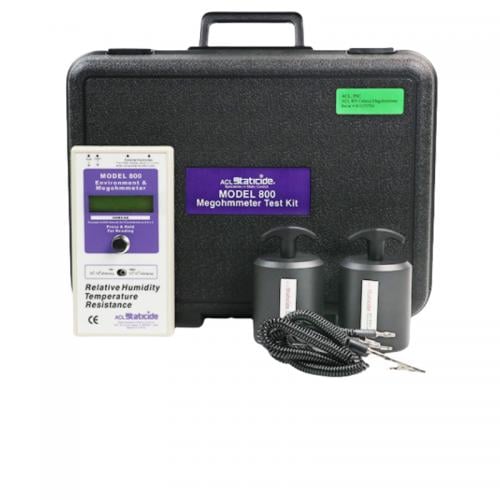
This week, the strongest development is new technical scrutiny of footwear–flooring performance; the remaining opportunities are semiconductor-market signals whose flooring implications are editorial inference.
Key development — industry analysis, not a standards change: In Compliance Magazine published a technical article on 1 September examining how flooring and footwear interact to generate walking body voltage. It warns that a floor marketed as “dissipative” may measure near ohms and still provide inadequate performance with particular footwear. Technical article, ESDA technical clarification
Why it matters: This directly supports a buyer-focused article explaining why resistance-to-ground data cannot replace testing the actual footwear–flooring combination. ANSI/ESD STM97.1 addresses system resistance, while STM97.2 measures voltage generated with a person.
Facts or claims to verify before publishing:
Key development — confirmed: Solvay disclosed on 3 September that it will more than double ultra-pure hydrogen-peroxide capacity at its Tainan joint venture—from 35,000 to more than 70,000 tonnes annually—by the end of 2026. The chemical is used in semiconductor wafer cleaning, and Solvay attributes the expansion to advanced-node capacity growth in Taiwan. Reuters report
Why it matters: The news supports an educational angle about flooring in semiconductor wet-process and chemical-support environments. Specifiers may need to evaluate chemical resistance, seam integrity, cleanability and slip performance alongside ESD properties. That requirement is a general technical inference; Solvay and Taiwanese fabs have not disclosed flooring specifications.
Facts or claims to verify before publishing:
Key development — government-reported pipeline, not finalized projects: Taiwan’s economy minister said on 2 September that Taiwanese companies were considering approximately USD 20 billion of additional U.S. investment, driven by semiconductor and AI demand. The companies, locations, project stages and individual commitments were not identified. Reuters report, Taiwan News coverage
Why it matters: This provides a timely framework for explaining when ESD-flooring decisions occur—from process-risk assessment and architectural specification through sample qualification, installation and acceptance testing. The announcement signals a possible project pipeline, not confirmed flooring demand.
Facts or claims to verify before publishing:
 Hot News
2026-08-12
2026-07-29
2026-07-28
2025-06-27
2025-06-24
2025-06-16

Herzesd is a professional supplier of full-range ESD products and custom static protection for electronics, labs, and industrial environments.
Floor 2, No.70, Licheng Road, Pudong District, Shanghai
Copyright © Shanghai Herzesd Industrial Co., Ltd All Rights Reserved Privacy Policy Blog
 EN
EN